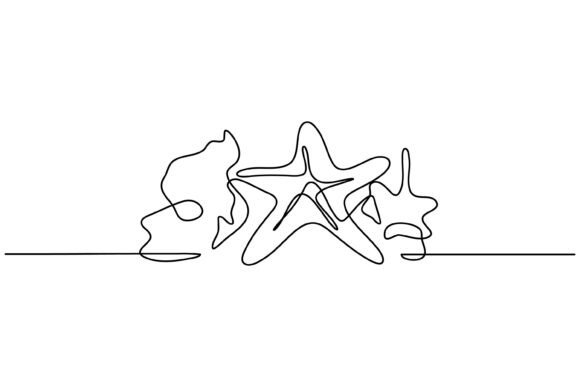
Continuous Line Design of Star Fish: Strategic Visual Clarity for Modern Branding
In an era defined by digital noise and visual saturation, the ability to communicate complex ideas with minimal friction is a competitive advantage. This is where the Continuous Line Design of Star Fish emerges not merely as an aesthetic choice, but as a strategic tool for clarity. By reducing organic forms to their essential contours using a single, unbroken stroke, this design philosophy forces a discipline of thought that resonates deeply with modern audiences. It is not just about drawing a sea creature; it is about mastering the art of reduction to enhance recognition, streamline production, and elevate brand perception.
For entrepreneurs, marketers, and creative professionals, understanding the utility of continuous line art—specifically focusing on marine motifs like starfish and ocean reefs—offers a pathway to more effective visual communication. The constraint of the single line demands intentionality. Every curve must serve a purpose, connecting one element to the next without interruption. This mirrors the operational efficiency many businesses strive for: seamless workflows, connected customer journeys, and clear value propositions. When you utilize a Continuous Line Design of Star Fish, you are leveraging a visual metaphor for continuity, resilience, and interconnectedness.
The Strategic Value of Minimalist Marine Motifs
The ocean is a vast, chaotic system, yet within it, organisms like the starfish exhibit radial symmetry and structural integrity. Capturing this through a continuous line design requires a deep understanding of form. For branding purposes, this translates to immediate cognitive ease for the viewer. The human brain processes simple, closed shapes faster than complex, fragmented illustrations. A starfish rendered in a single line is instantly recognizable, scalable, and versatile across media formats.
Consider the application in corporate identity. A logo or icon based on the Continuous Line Design of Star Fish can serve as a anchor for a brand narrative centered on sustainability, exploration, or calm. Unlike photorealistic imagery, which can feel dated or cluttered on small mobile screens, vector-based line art remains crisp and legible at any size. This scalability is crucial for decision-makers who need assets that perform equally well on a business card, a website favicon, or a large-scale outdoor advertisement.
Furthermore, the inclusion of reef structures alongside the starfish expands the narrative scope. Reefs represent diversity, ecosystem health, and community. When drawn with the same continuous line technique, they complement the starfish without competing for attention. This combination allows creators to tell a richer story about ocean diversity while maintaining a cohesive visual language. The interplay between the solitary starfish and the complex reef structure creates a balance between individuality and community, a theme that resonates strongly in contemporary social and corporate messaging.
Technical Precision and Asset Versatility
To leverage these designs effectively, one must understand the technical deliverables. High-quality continuous line art is not simply a raster image; it is a mathematical construct. When you acquire or create these assets, you typically receive them in three key formats: EPS, SVG, and JPG. Each serves a distinct strategic function in your operational workflow.
- EPS (Encapsulated PostScript): This is the industry standard for print production. If you are a publisher, small business owner, or marketer preparing materials for physical distribution, EPS ensures that your Continuous Line Design of Star Fish retains perfect edge quality regardless of the printing method. It allows printers to scale the image without pixelation, ensuring professional results.
- SVG (Scalable Vector Graphics): For digital-first entrepreneurs and web developers, SVG is indispensable. These files are code-based, meaning they load quickly, are searchable by engines, and can be manipulated via CSS for interactive web experiences. An SVG of a starfish can change color on hover or animate smoothly, enhancing user engagement without sacrificing performance.
- JPG (Joint Photographic Experts Group): While less flexible than vector formats, JPGs are universal. They are ideal for quick previews, social media posts, or internal presentations where editing capabilities are not required. Having a high-resolution JPG on a white background ensures immediate usability for non-technical team members.
Understanding these formats allows you to make better decisions about resource allocation. You do not need to convert files repeatedly, which saves time and reduces the risk of quality degradation. By starting with the right source files, you streamline your creative operations and ensure consistency across all touchpoints.
Intentional Application in Branding and Communication
Using continuous line art randomly can dilute its impact. To achieve better results, you must align the visual style with your strategic goals. Ask yourself: What does the unbroken line represent in my context? Is it the continuity of service? The interconnectedness of a global team? The endless cycle of sustainability?
For educators and bloggers, these decorative elements can break up text-heavy content, providing visual rest points that improve readability and retention. The simplicity of the Continuous Line Design of Star Fish draws the eye without distracting from the core message. It acts as a visual punctuation mark, guiding the reader through the narrative flow.
In customer experience design, such elements can soften the rigidity of corporate interfaces. A checkout page or a confirmation email adorned with subtle, single-line marine motifs can evoke a sense of calm and trust. This emotional resonance is a subtle but powerful driver of conversion. However, this only works if the design feels integrated rather than tacked on. The line weight, curvature, and spacing must harmonize with your existing typography and color palette.
Risks of Contextual Misalignment
While versatile, continuous line design is not a universal solution. One significant risk is overuse. If every element of your brand identity relies on thin, delicate lines, the overall impression may lack authority or presence. It is crucial to balance these decorative elements with bolder typographic choices or solid color blocks to create visual hierarchy.
Another consideration is accessibility. Very fine lines may disappear on low-resolution screens or for users with visual impairments. When implementing SVG or EPS files, ensure that line weights are sufficient for visibility across devices. Testing your Continuous Line Design of Star Fish on various backgrounds is essential. While the standard presentation is on a white background, real-world applications often involve colored or textured surfaces. Ensure there is enough contrast to maintain legibility.
Planning for Long-Term Visual Consistency
Successful branding is a long-term game. Adopting a specific artistic style like continuous line art requires commitment to consistency. Once you establish this visual language, it should permeate your marketing materials, product packaging, and digital presence. This repetition builds recognition. Over time, the single-line starfish becomes synonymous with your brand’s values.
To maintain this consistency, create a style guide that dictates how these elements are used. Define minimum sizes, acceptable color variations, and clear space requirements. Specify when to use the starfish alone versus when to combine it with reef elements. This governance prevents fragmentation of your visual identity as your team grows or as you outsource design tasks.
Moreover, consider the evolutionary potential of the design. Can the continuous line concept expand to other marine life? Can it adapt to seasonal campaigns? By planning for flexibility within the constraints of the style, you ensure that your visual assets remain fresh and relevant without losing their core identity.
Making the Decision to Invest in Quality Assets
For freelancers and small business owners, the decision to purchase or commission high-quality vector assets is an investment in efficiency. Creating precise continuous line art from scratch requires significant skill and time. Sourcing professional EPS and SVG files allows you to bypass the learning curve and focus on implementation.
When evaluating assets, look for clean nodes and smooth bezier curves. Poorly constructed vectors can cause issues when scaling or editing. A well-drawn Continuous Line Design of Star Fish will have a logical flow, with no overlapping lines unless intentionally designed for depth. This technical quality ensures that the asset behaves predictably in design software.
Ultimately, the goal is to use design to solve problems. Whether you are trying to differentiate your brand in a crowded market, simplify your user interface, or convey a message of environmental stewardship, the strategic use of continuous line art offers a sophisticated, understated solution. It respects the intelligence of your audience by avoiding visual clutter and delivering clarity. By approaching these decorative elements with intention and strategic foresight, you transform simple drawings into powerful tools for communication and growth.